Tehran Bids Farewell to Ayatollah Ali Khamenei Amidst Widespread Mourning
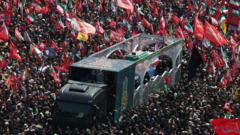
Tehran witnessed an immense outpouring of public grief as hundreds of thousands of mourners lined its streets for the funeral procession of Ayatollah Ali Khamenei, Iran's late supreme leader. Khamenei was reportedly killed during the initial stages of a conflict involving the United States and Israel. State television broadcasts showcased vast throngs of people observing the flag-draped coffin of the former leader as it was transported on a lorry along a 10-kilometer route, passing through significant landmarks including the capital's Enghelab Square.
The procession followed a two-day period during which Khamenei's body lay in state at Tehran's Grand Mosalla mosque. On Sunday, three of his sons were observed praying beside the coffin. However, Mojtaba Khamenei, who has since assumed the role of supreme leader, was conspicuously absent from public view. Reports indicate he has not been seen publicly since sustaining severe injuries in the same Israeli air strike on February 28 in Tehran, which also claimed the lives of his father and wife.
A Nation's Display of Unity and Defiance
The funeral cortege proceeded slowly through the heart of Tehran, moving from Imam Hossein Square in the east to Azadi Square in the west, marking the final day of a three-day period of public mourning in the capital. Iranian state media estimated that millions of individuals filled the primary thoroughfares connecting these squares, gathering around the vehicle carrying the late supreme leader's coffin, accompanied by four family members.
Many mourners were seen waving Iranian flags and red banners, symbols often associated with vengeance. Placards bearing messages such as "We must rise" and calls for the death of US President Donald Trump were also visible. Trump, alongside Israeli Prime Minister Benjamin Netanyahu, reportedly ordered a joint attack on Iran four months prior, an action that initiated a conflict resulting in thousands of casualties. Some attendees were observed throwing stones at a billboard displaying Trump's image, which was suspended from a bridge, with a message stating, "The US killed our father. We won't let you go!"
Melika Nourian, a 22-year-old university student, conveyed to the AFP news agency her motivation for attending: "I came with honour and pride to show all the people of the world how much we loved him and how committed we are to the system, the people, and the Islamic Republic."
Prominent Figures Attend, Successor Remains Absent
Among the notable attendees at the procession was former president Mahmoud Ahmadinejad, marking what appeared to be his first significant public appearance since the war's commencement. Reports suggest that three of his bodyguards were killed in a strike near his residence during the conflict. Iran's current president, Masoud Pezeshkian, was also filmed walking amongst the mourners in a Tehran street. Earlier, Pezeshkian had posted on X, stating that Khamenei had instilled in Iranians the understanding that the nation's "greatest asset" was "its people and their unity," vowing that Iranians would "continue the path of Iran's honour, progress, and glory."
Other senior officials featured in state media coverage included Foreign Minister Abbas Araghchi, judiciary chief Gholamhossein Mohseni Ejei, and Brig-Gen Esmail Qaani, commander of the Quds Force, the Revolutionary Guards' overseas operations arm. Despite the presence of these high-ranking individuals, Mojtaba Khamenei, the new supreme leader, remained absent from public view. He has reportedly not appeared in videos or publicly since his appointment, communicating primarily through written statements.
Israeli Defence Minister Israel Katz publicly stated that Ali Khamenei was "eliminated by Israel" due to his perceived threats to Israel's existence, adding a warning that "Any Iranian leader who will again try to pursue plans to destroy Israel will be killed as well."
Khamenei's Legacy and Future Implications
Ali Khamenei, who was 86 at the time of his death, assumed the position of supreme leader in 1989 following the passing of Ayatollah Ruhollah Khomeini, the founder of the Islamic Republic. Throughout his 37-year tenure, he exerted considerable control over Iran's political landscape and its armed forces, often employing forceful measures to suppress internal challenges. He consistently adopted unyielding positions on international issues, particularly concerning Iran's relations with the US and Israel.
The Iranian establishment views the funeral ceremonies as an opportunity to project an image of national strength and resilience, particularly in the aftermath of the recent conflict and the mass protests that swept across the country in January, which were met with a severe crackdown by security forces resulting in thousands of fatalities. Ayatollah Mohammad Saidi, the Qom Friday prayer leader, declared last week that a substantial turnout "will, in effect, be another referendum for the Islamic Republic."
These ceremonies are unfolding less than three weeks after Iran and the US signed a preliminary accord aimed at ending the war and reopening the vital Strait of Hormuz waterway, a critical passage for 20% of global oil and gas shipments. Both nations have allocated two months to finalize a comprehensive agreement addressing Iran's nuclear program, US sanctions, and establishing a permanent truce. Mediator Qatar reported "positive progress" in indirect talks held in Doha last week, following a four-day exchange of strikes, with the next meeting scheduled after the conclusion of Khamenei's funeral rites.
Further ceremonies are planned, including another funeral procession and prayers on Tuesday in Qom, a significant center for Iran's Shia Muslim clerical establishment, where Khamenei's body was transported by helicopter on Monday evening. The ceremonies will then proceed to the Iraqi shrine cities of Karbala and Najaf on Wednesday, culminating on Thursday with Khamenei's burial at the Imam Reza shrine in his hometown of Mashhad, in north-eastern Iran.
Source: Huge crowds fill Tehran streets for Khamenei's funeral procession